Digestion is one of the most important processes taking place inside the human body. Every time we eat food, our digestive system begins a series of activities that help turn that food into nutrients the body can use. These nutrients provide energy, support growth, repair damaged tissues, and help different organs work properly.
Most people think digestion happens only in the stomach. However, the process actually begins in the mouth and continues through several organs before the remaining waste leaves the body. Each organ has a particular responsibility, and all of them work together to complete the digestive process.
Understanding what happens inside the body during digestion can help us appreciate how the human body uses food. It also explains why eating habits, hydration, and food choices are important for maintaining digestive health.
What Is Digestion in the Human Body?
Digestion is the natural process through which the body breaks food into smaller substances that can be absorbed and used by cells.
The food we eat contains carbohydrates, proteins, fats, vitamins, minerals, and water. Many of these nutrients cannot be used immediately in their original form. The digestive system must first break large food molecules into smaller components.
For example, carbohydrates are broken down into simple sugars, proteins into amino acids, and fats into fatty acids and other smaller molecules.
Once these substances become small enough, they pass through the intestinal lining and enter the blood or lymphatic system.
The body then transports these nutrients to different tissues and organs where they are needed.
Digestion involves two main types of processes.
Mechanical digestion involves physically breaking food into smaller pieces through chewing and muscular movements.
Chemical digestion involves digestive enzymes and other substances that break food molecules into smaller components.
Both processes are necessary for efficient digestion.
How Digestion Begins in the Mouth
The digestive process begins as soon as food enters the mouth.
When we chew, our teeth cut, crush, and grind food into smaller pieces. This makes the food easier to swallow and increases the surface area available for digestive enzymes.
At the same time, the salivary glands release saliva.
Saliva moistens food and makes it easier to move through the digestive tract. It also contains an enzyme called salivary amylase, which begins breaking down certain carbohydrates, especially starch.
For example, when we eat bread, rice, or potatoes, the digestion of starch begins in the mouth.
The tongue helps mix food with saliva and forms it into a soft mass called a bolus.
Once the food is ready, the tongue pushes it toward the throat, where swallowing begins.
Chewing food thoroughly supports the first stage of digestion and makes swallowing easier.
What Happens When Food Travels Through the Esophagus?
After swallowing, food moves from the mouth into the esophagus.
The esophagus is a muscular tube connecting the throat to the stomach. Its primary responsibility is to transport swallowed food.
Food does not simply fall into the stomach through gravity.
Instead, the walls of the esophagus produce coordinated muscular contractions called peristalsis.
These movements push food downward toward the stomach.
A ring of muscle known as the lower esophageal sphincter helps control the passage of food into the stomach.
Normally, this muscle relaxes to allow food to enter the stomach and then closes to reduce the movement of stomach contents back into the esophagus.
When this protective mechanism does not work properly, stomach acid may move upward and cause acid reflux.
Although food travels through the esophagus relatively quickly, this stage is essential for moving it safely toward the stomach.
What Happens to Food Inside the Stomach?
The stomach plays an important role in both mechanical and chemical digestion.
Once food reaches the stomach, its muscular walls begin contracting to mix the food with digestive juices.
The stomach produces gastric juice, which contains hydrochloric acid and digestive enzymes.
Hydrochloric acid creates an acidic environment that helps activate certain enzymes and destroy many microorganisms that enter with food.
One important digestive enzyme in the stomach is pepsin.
Pepsin begins breaking proteins into smaller protein fragments.
The stomach also produces mucus that helps protect its lining from the strong acid.
As the stomach muscles continue mixing food, it gradually becomes a thick liquid mixture called chyme.
The stomach does not release all its contents into the small intestine at once.
Instead, a muscular opening called the pyloric sphincter controls the movement of chyme into the first part of the small intestine.
The time food remains in the stomach varies depending on the amount and composition of the meal. Meals containing more fat generally take longer to leave the stomach.
How the Small Intestine Completes Digestion
The small intestine is where most chemical digestion and nutrient absorption take place.
Despite its name, the small intestine is much longer than the large intestine. It consists of three main sections called the duodenum, jejunum, and ileum.
When chyme enters the duodenum, it mixes with digestive fluids from the pancreas, liver, and intestinal lining.
These fluids help break down carbohydrates, proteins, and fats into substances that can be absorbed.
The small intestine also produces enzymes that complete important stages of digestion.
Its muscular walls continuously move and mix intestinal contents, allowing food particles to come into contact with digestive enzymes.
Once nutrients have been broken down sufficiently, they are ready to pass through the intestinal lining.
This stage is especially important because digestion alone is not enough. Nutrients must also be absorbed before the body can use them.
What Is the Role of the Pancreas in Digestion?
The pancreas is an important organ that helps the digestive system process food.
It produces digestive enzymes that enter the small intestine through the pancreatic duct.
Different pancreatic enzymes perform different functions.
Pancreatic amylase helps digest carbohydrates.
Proteases, including trypsin, help break proteins into smaller fragments.
Pancreatic lipase helps digest fats.
The pancreas also releases bicarbonate, which helps neutralize the acidic mixture arriving from the stomach.
This creates a more suitable environment for digestive enzymes to work.
Without enough pancreatic digestive enzymes, the body may struggle to digest and absorb nutrients properly.
The pancreas also produces hormones such as insulin and glucagon, which help regulate blood sugar. However, this is a separate function from its direct role in digestion.
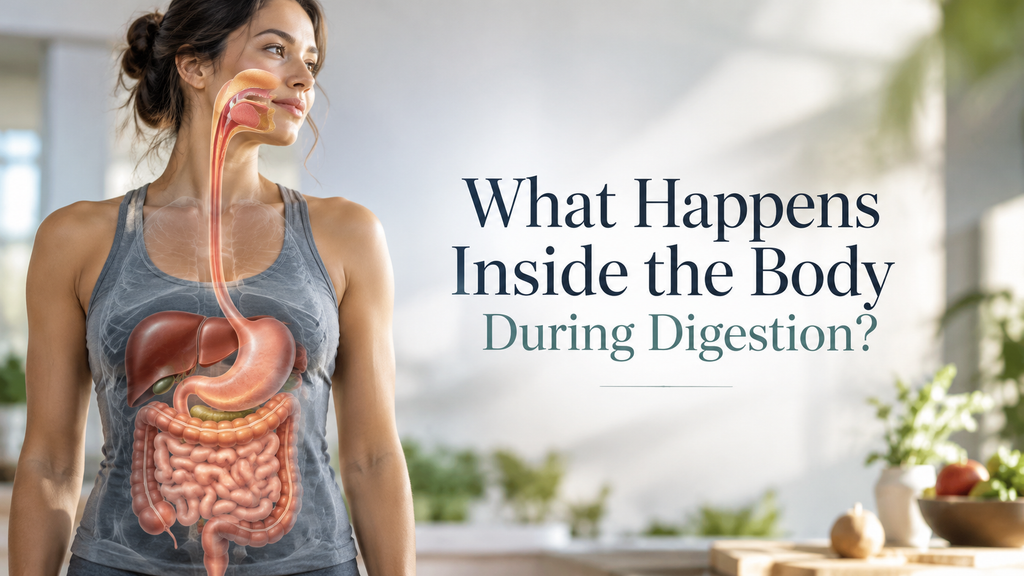
How the Liver and Gallbladder Help Digest Fats
The liver and gallbladder work together to support fat digestion.
The liver produces bile, a digestive fluid that helps the body process dietary fats.
Bile contains substances called bile salts that help break large fat droplets into smaller droplets.
This process is called emulsification.
Emulsification increases the surface area available for digestive enzymes to act on fats.
The gallbladder stores and concentrates bile produced by the liver.
When food containing fat reaches the small intestine, the gallbladder can release bile into the digestive tract.
Bile does not directly digest fats using enzymes. Instead, it makes fat digestion and absorption more effective.
This process also helps the body absorb certain vitamins, including vitamins A, D, E, and K.
These vitamins are known as fat soluble vitamins because their absorption depends partly on the normal handling of dietary fats.
How Nutrients Are Absorbed Into the Body
After food has been broken down, the next important stage is nutrient absorption.
The inner surface of the small intestine contains millions of tiny projections called villi.
Each villus contains even smaller structures called microvilli.
Together, these structures greatly increase the surface area available for absorption.
Most simple sugars and amino acids enter small blood vessels within the intestinal lining.
They then travel through the bloodstream, with many passing first to the liver for processing.
Most long chain dietary fats follow a different pathway.
After being absorbed by intestinal cells, they are packaged into particles called chylomicrons and enter the lymphatic system before reaching the bloodstream.
Vitamins, minerals, and water are also absorbed through the digestive tract.
The absorbed nutrients eventually reach the body’s cells, where they support energy production, maintenance, growth, and repair.
This is how the food we eat becomes useful to the human body.
What Happens Inside the Large Intestine?
After most nutrients have been absorbed, the remaining material enters the large intestine.
The large intestine includes the colon and rectum.
Its main responsibilities include absorbing remaining water and electrolytes, processing certain undigested materials, and forming stool.
As material moves through the colon, water is gradually absorbed.
This helps transform the remaining contents into more solid waste.
The large intestine also contains a large population of microorganisms known collectively as the gut microbiota.
Many of these microorganisms help ferment dietary fibers and other substances that human digestive enzymes cannot break down.
During fermentation, some bacteria produce short chain fatty acids that can support the cells lining the colon.
However, bacterial fermentation can also produce gases.
This is one reason certain foods may cause bloating or increased gas in some people.
The amount of gas produced varies depending on the type of food, the gut microbiota, and individual digestive differences.
How Waste Leaves the Digestive System
The final stage of digestion involves removing material that the body cannot absorb or use.
After passing through the large intestine, the remaining waste is stored in the rectum.
When enough stool collects, stretch receptors send signals that create the urge to have a bowel movement.
Muscles in the rectum and anus work together to control the release of stool.
This process is called defecation.
Stool usually contains water, bacteria, undigested food components, intestinal cells, and other waste substances.
Regular bowel movements help the body eliminate this remaining material.
However, normal bowel movement frequency differs from person to person. Some people pass stool several times a day, while others do so less frequently.
Comfort, stool consistency, and changes from a person’s normal pattern are often more useful indicators than frequency alone.
How Long Does the Complete Digestive Process Take?
Digestion does not happen at the same speed for everyone.
The time required depends on the type of food, meal size, hydration, physical activity, medications, and individual digestive function.
The stomach typically empties a meal into the small intestine over several hours.
Movement through the small intestine usually takes a few more hours.
The remaining material may stay in the large intestine much longer.
Overall, the journey from eating food to eliminating the remaining waste often takes approximately one to three days, although normal variation can be considerable.
For example, a meal containing a large amount of fat may leave the stomach more slowly than a lighter meal.
Foods containing dietary fiber can also influence the movement and consistency of material passing through the intestines.
Understanding these differences helps explain why digestion does not follow exactly the same schedule every day.
Why Digestive Enzymes Are Important
Digestive enzymes are specialized proteins that help break food into smaller molecules.
Each type of enzyme works on particular nutrients.
Amylase helps digest starch.
Proteases help digest proteins.
Lipase helps digest fats.
Other enzymes, such as lactase, help digest specific sugars.
Lactase breaks down lactose, the natural sugar found in milk.
People who do not produce enough lactase may experience gas, bloating, or diarrhea after consuming lactose containing dairy products.
This condition is called lactose intolerance.
Most healthy people naturally produce the digestive enzymes they need.
Digestive enzyme supplements are not automatically necessary for everyone and should be used when there is an appropriate reason.
How to Support a Healthy Digestive System
Healthy digestion depends on the coordinated function of several organs, but everyday habits can also influence digestive comfort.
Eating a balanced diet helps supply nutrients and supports normal digestive processes.
Fiber from fruits, vegetables, whole grains, and other plant foods helps maintain healthy bowel function.
However, increasing fiber too quickly may cause gas or bloating, so gradual changes are often more comfortable.
Drinking enough water supports normal body functions and helps prevent dehydration, which can contribute to constipation.
Regular physical activity can also support bowel movement patterns.
Eating slowly and chewing food properly may reduce the amount of air swallowed while eating and improve mealtime comfort.
Sleep and stress management can also influence digestive symptoms because the nervous system and digestive tract communicate closely.
Persistent abdominal pain, difficulty swallowing, blood in the stool, unexplained weight loss, or ongoing changes in bowel habits should be discussed with a healthcare professional.
These symptoms may require medical evaluation rather than simple dietary changes.
How the Brain and Digestive System Work Together
The digestive system does not work independently from the brain.
The brain and digestive tract communicate through nerves, hormones, and chemical signals.
This connection is often called the gut brain axis.
The enteric nervous system, a network of nerve cells within the digestive tract, helps coordinate muscular movement, secretion, and other digestive activities.
The vagus nerve is one of the important communication pathways connecting the brain and digestive organs.
These connections help explain why emotions and stress can influence digestion.
For example, some people experience stomach discomfort, nausea, or changes in bowel habits during stressful situations.
Hunger and fullness signals also involve communication between the digestive system and brain.
Hormones released by the digestive tract provide information about food intake and energy needs.
This coordination helps the body regulate eating behavior and digestive activity.
Conclusion
The process of digestion is a remarkable example of how different organs work together to keep the human body functioning.
Digestion begins in the mouth, where chewing and saliva start breaking down food. The esophagus then carries food to the stomach, where acid, enzymes, and muscular movements continue the process.
The small intestine completes most digestion and absorbs nutrients with assistance from the pancreas, liver, and gallbladder. The large intestine absorbs remaining water, supports gut microorganisms, and prepares waste for removal.
Every stage has a specific purpose, and each contributes to the body’s ability to obtain energy and essential nutrients.
Learning what happens inside the body during digestion also shows why everyday habits matter. Balanced meals, adequate hydration, regular activity, and attention to digestive symptoms can all support digestive health.
The digestive system is more than a pathway for food. It is a carefully coordinated network that transforms what we eat into the substances our bodies need to survive, grow, and function properly.