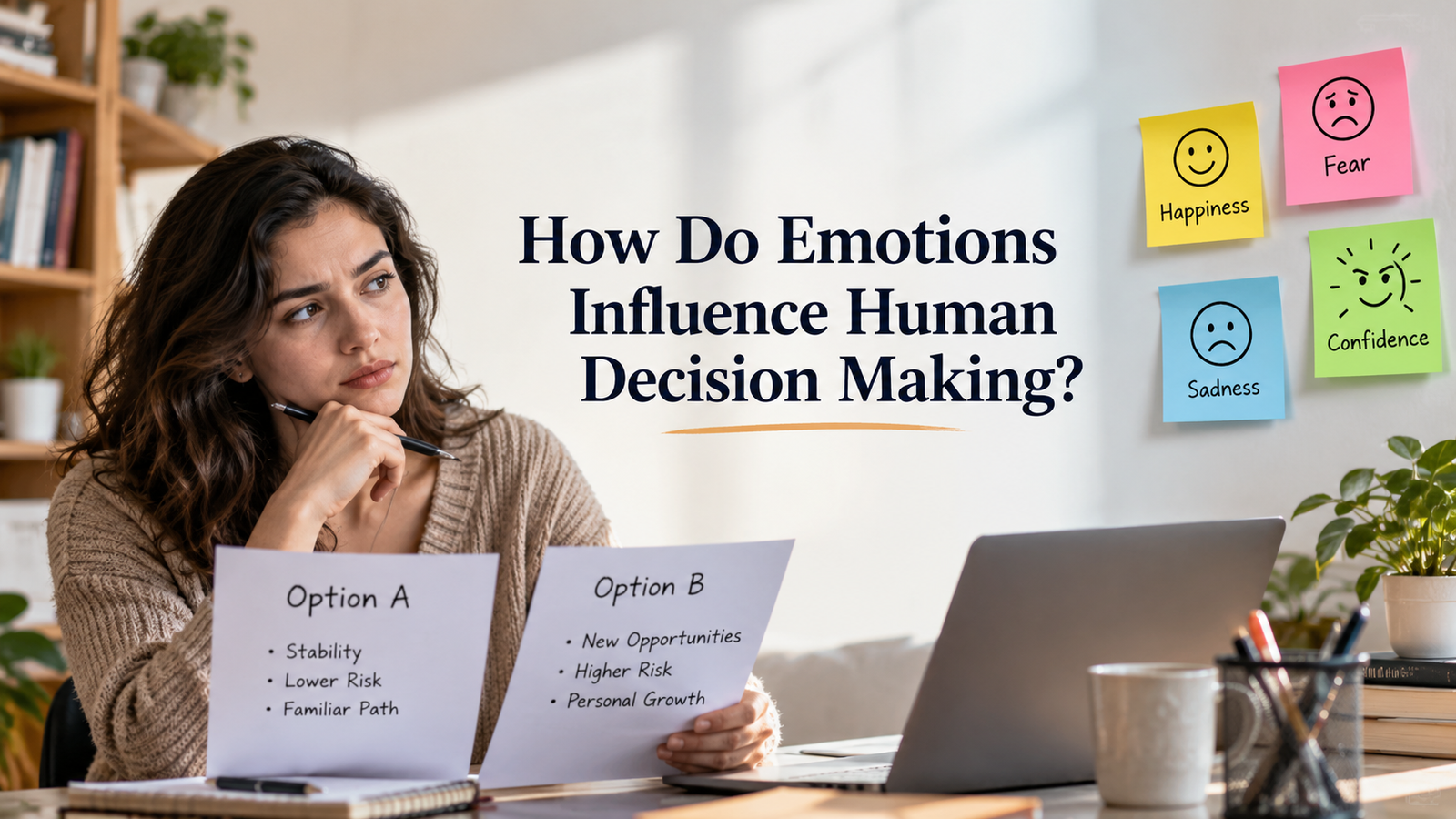
Human beings make hundreds of decisions every day. Some decisions are simple, such as choosing what to eat, deciding when to sleep, or selecting clothes for work. Others are more important, including choosing a career, managing money, building relationships, and making decisions about health. Although people often believe that their choices are based on logical thinking, emotions also play a major role in the decision making process.
Emotions influence how we understand situations, evaluate risks, remember experiences, and respond to challenges. Feelings such as happiness, fear, anger, sadness, and excitement can change the way we think about available options.
Understanding how emotions influence human decision making is important because it helps us recognize why we make certain choices. It also teaches us how to balance emotional reactions with careful thinking.
What Is Emotional Decision Making?
Emotional decision making is the process of making choices that are influenced by feelings and emotional experiences. These feelings can affect our judgment, attention, and understanding of a situation.
For example, a person who feels excited about a new business opportunity may focus mainly on its possible benefits. Another person who feels afraid of financial loss may pay more attention to the risks.
Both individuals may be looking at the same opportunity, but their emotions influence how they interpret the information.
This does not mean that emotional decisions are always wrong. Emotions provide useful information about personal needs, values, and experiences.
However, problems can arise when strong feelings prevent someone from considering important facts.
The healthiest approach is often to recognize emotional signals while also examining the available evidence.
How Does the Brain Process Emotions and Decisions?
The human brain contains several connected systems that work together during decision making.
One important structure is the amygdala, which helps the brain detect emotionally significant information, including possible threats.
The prefrontal cortex is involved in planning, evaluating consequences, controlling impulses, and making complex decisions.
Another important area is the ventromedial prefrontal cortex, which helps connect emotional information with personal values and possible outcomes.
These brain regions do not work independently. They continuously exchange information as people interpret situations and decide how to respond.
For example, imagine walking along a road and suddenly hearing a loud noise. Your brain may quickly recognize a possible danger and prepare you to react.
Later, when you understand that the sound came from a harmless source, other brain processes help you evaluate the situation more carefully.
This example shows how emotional responses and rational thinking cooperate to guide human behavior.
Why Are Emotions Important in Decision Making?
Emotions help people identify what matters to them.
Without emotional information, even ordinary decisions could become more difficult because people would struggle to determine which outcomes are personally meaningful.
Consider someone choosing between two jobs.
One job offers a higher salary, while another provides better working conditions and more time with family.
Logical thinking helps compare salaries, working hours, and career opportunities.
Emotions help the person understand personal satisfaction, comfort, and family priorities.
A good decision usually considers both practical information and emotional needs.
Emotions also support learning by helping the brain remember experiences associated with positive or negative outcomes.
These memories may influence future choices.
How Does Happiness Affect Human Decisions?
Happiness can influence decision making by changing how people view themselves, other individuals, and future possibilities.
When people feel happy, they may become more optimistic, creative, and open to new experiences.
Positive emotions can encourage cooperation, social interaction, and flexible thinking.
For example, a student who receives excellent examination results may feel more confident about applying for a challenging academic program.
Similarly, a person celebrating a professional achievement may become more willing to explore new opportunities.
However, happiness does not guarantee better judgment.
Sometimes, a very positive mood can cause people to underestimate difficulties or overlook warning signs.
An individual who feels unusually excited about purchasing an expensive product might focus on enjoyment rather than affordability.
Therefore, even positive emotions should be balanced with careful evaluation.
How Does Fear Influence Decision Making?
Fear is a natural emotion that helps protect human beings from danger.
When the brain recognizes a possible threat, fear can increase attention and prepare the body to respond.
This reaction is useful in situations involving physical danger or immediate safety concerns.
For example, a driver who notices a vehicle approaching too quickly may become afraid and immediately reduce speed.
In this situation, fear supports a protective decision.
However, fear can also influence choices when the danger is uncertain or exaggerated.
A person may avoid applying for a better job because of the possibility of rejection.
Another individual may refuse to learn a new skill because they are afraid of making mistakes.
These decisions may reduce temporary discomfort but can also limit personal development.
Learning to distinguish realistic danger from unnecessary fear can improve decision making.
How Does Anger Affect Judgment?
Anger is another powerful emotion that can change human judgment.
People often experience anger when they feel threatened, treated unfairly, or disappointed.
During intense anger, attention may become focused on the immediate problem rather than the possible consequences of a response.
For example, an employee who receives unexpected criticism may feel angry and consider resigning immediately.
After becoming calm, the same employee may realize that discussing the issue with a supervisor would be more useful.
Anger can sometimes motivate positive action, especially when people recognize injustice and work toward meaningful change.
However, uncontrolled anger may increase impulsive behavior, unnecessary arguments, and poor communication.
Allowing time for emotional intensity to decrease can help individuals make more thoughtful decisions.
How Does Sadness Influence Choices?
Sadness can influence attention, motivation, and the way people evaluate situations.
When someone feels sad, they may become more focused on negative experiences or possible losses.
Some people also withdraw from social activities or postpone important choices during periods of sadness.
For example, a student disappointed by poor examination results may begin believing that future academic success is impossible.
This emotional reaction may reduce motivation, even when improvement is achievable through practice.
Sadness can also encourage reflection.
A person experiencing disappointment may reconsider personal priorities and identify areas that require change.
The effect of sadness depends on its intensity, duration, and the circumstances surrounding it.
Recognizing sadness without allowing it to control every decision can support healthier thinking.
The Relationship Between Stress and Decision Making
Stress affects both emotional reactions and mental performance.
When people experience stress, the body activates physiological responses involving hormones such as adrenaline and cortisol.
These responses help the body prepare for demanding situations.
Short periods of manageable stress can sometimes improve alertness and concentration.
However, intense or prolonged stress may interfere with attention, working memory, and flexible thinking.
For example, a person facing several urgent responsibilities may struggle to compare different solutions carefully.
Instead, they may choose the first available option simply to reduce pressure.
This does not mean that everyone makes poor decisions under stress. The effects vary depending on the individual, situation, and level of stress.
Developing healthy stress management habits can create better conditions for thoughtful decision making.
How Do Emotions Influence Financial Decisions?
Money related decisions provide clear examples of emotional influence.
People regularly make financial choices involving shopping, saving, investing, borrowing, and budgeting.
Fear may cause someone to avoid reasonable financial opportunities.
Excitement may encourage unnecessary spending.
Social pressure may lead an individual to purchase expensive products to impress others.
For example, advertisements often use positive emotions by connecting products with happiness, success, comfort, or belonging.
A customer may feel attracted to a product because of these associations rather than its actual usefulness.
Emotional awareness can help people separate genuine needs from temporary desires.
Before making an expensive purchase, it is useful to compare prices, consider affordability, and examine whether the product provides lasting value.
How Do Emotions Affect Relationships?
Emotions strongly influence decisions involving family members, friends, colleagues, and romantic partners.
Feelings such as love, trust, jealousy, disappointment, and sympathy can shape how people interpret the behavior of others.
For example, someone who trusts a close friend may accept advice more readily than advice from an unfamiliar person.
Trust can support cooperation and strong relationships.
However, excessive trust without careful judgment may sometimes create problems.
Similarly, jealousy may lead a person to misunderstand an ordinary social interaction.
Emotional reactions can affect communication, especially during disagreements.
Listening carefully, asking questions, and avoiding immediate assumptions can improve relationship decisions.
Healthy relationships require emotional understanding as well as respect, honesty, and clear communication.
The Role of Emotional Intelligence in Decision Making
Emotional intelligence refers to abilities related to recognizing, understanding, and managing emotions in ourselves and responding appropriately to the emotions of others.
These abilities can support better communication, self awareness, and decision making.
A person with strong emotional awareness may notice when anger is influencing their judgment.
Instead of responding immediately, they may choose to discuss the issue after becoming calmer.
Emotional intelligence also helps individuals recognize how other people may feel during important situations.
For example, a manager making workplace decisions should consider both organizational requirements and the possible emotional effects on employees.
Understanding emotions does not mean allowing feelings to determine every outcome.
It means recognizing their influence and responding thoughtfully.
Can Emotions Improve Decision Making?
Emotions are sometimes described as obstacles to logical thinking, but they can also improve decisions.
Emotional experiences help individuals recognize personal values and identify situations that deserve attention.
Feelings of compassion may encourage someone to help a person in need.
Concern about future health may motivate healthier habits.
Pride in completing a difficult task may encourage further learning and improvement.
Emotions can also help people learn from previous experiences.
For example, remembering the disappointment caused by an irresponsible purchase may encourage better budgeting in the future.
The important point is that emotions provide information rather than complete answers.
They become most useful when combined with evidence, experience, and careful reasoning.
Why Do People Sometimes Make Impulsive Decisions?
Impulsive decisions happen when people act quickly without adequately considering the consequences.
Strong emotions can increase the likelihood of impulsive behavior, particularly when immediate rewards or intense discomfort are involved.
For example, someone feeling frustrated after a difficult day may purchase an expensive item for temporary emotional relief.
Another person may send an angry message without thinking about how it could affect a relationship.
Impulsive behavior is not always harmful. Quick decisions can be useful when immediate action is necessary.
However, important choices involving money, relationships, education, and health usually benefit from additional thought.
Recognizing emotional triggers can help people reduce unnecessary impulsive decisions.
How Can We Make Better Decisions When Emotions Are Strong?
Improving emotional decision making does not require removing emotions. Instead, it involves developing habits that support clear thinking.
1. Identify Your Emotions
Before making an important choice, consider what you are feeling.
Ask yourself whether fear, anger, excitement, or disappointment is influencing your judgment.
Naming an emotion can make it easier to examine your response.
2. Give Yourself Enough Time
Not every decision requires an immediate answer.
When possible, avoid making major commitments during periods of intense emotional pressure.
A short break may help you reconsider the situation.
3. Examine the Available Facts
Emotions may highlight certain details while reducing attention to others.
Try to identify reliable information before reaching a conclusion.
Consider what you know, what remains uncertain, and what additional information could help.
4. Think About Long Term Consequences
A decision that provides immediate satisfaction may create difficulties later.
Consider how your choice might affect your future health, finances, relationships, or personal goals.
5. Seek Another Perspective
Talking with a trusted person can introduce ideas that you may have overlooked.
Different perspectives can be especially useful when emotions make a situation feel overwhelming.
6. Learn From Previous Decisions
Reflect on past choices and their outcomes.
Consider when emotional reactions helped you and when they created unnecessary problems.
This practice can improve self awareness over time.
How Do Past Experiences Shape Emotional Decisions?
Human emotions are closely connected with memory.
Experiences involving happiness, embarrassment, fear, or disappointment can influence how people respond to similar situations in the future.
For example, someone who experienced a financial loss may become more cautious about future investments.
A student who received encouragement after giving a presentation may feel more confident speaking publicly again.
These emotional memories can be helpful because they allow people to learn from experience.
However, previous experiences do not always predict future outcomes.
A single negative event may cause someone to avoid opportunities that are actually safe or beneficial.
Understanding this connection can help individuals evaluate new situations based on current evidence rather than past feelings alone.
How Does Emotional Awareness Support Personal Growth?
Emotional awareness is an important part of personal development.
People who understand their emotional patterns may become better at recognizing triggers, managing reactions, and learning from mistakes.
For example, someone who notices that stress increases unnecessary spending can develop a habit of reviewing purchases before buying.
A person who becomes impatient during disagreements can practice listening before responding.
Over time, these habits may support better relationships, stronger self control, and more confident decision making.
Emotional awareness is a skill that can develop through reflection, experience, and consistent practice.
Conclusion
Emotions influence human decision making in many important ways. Happiness can encourage optimism, fear can increase caution, anger can motivate immediate action, and sadness can change how people evaluate their circumstances.
These emotional responses are natural parts of human life. They help us recognize danger, understand personal values, build relationships, and learn from experience.
However, strong emotions can sometimes lead to impulsive choices or inaccurate judgments when people overlook important facts.