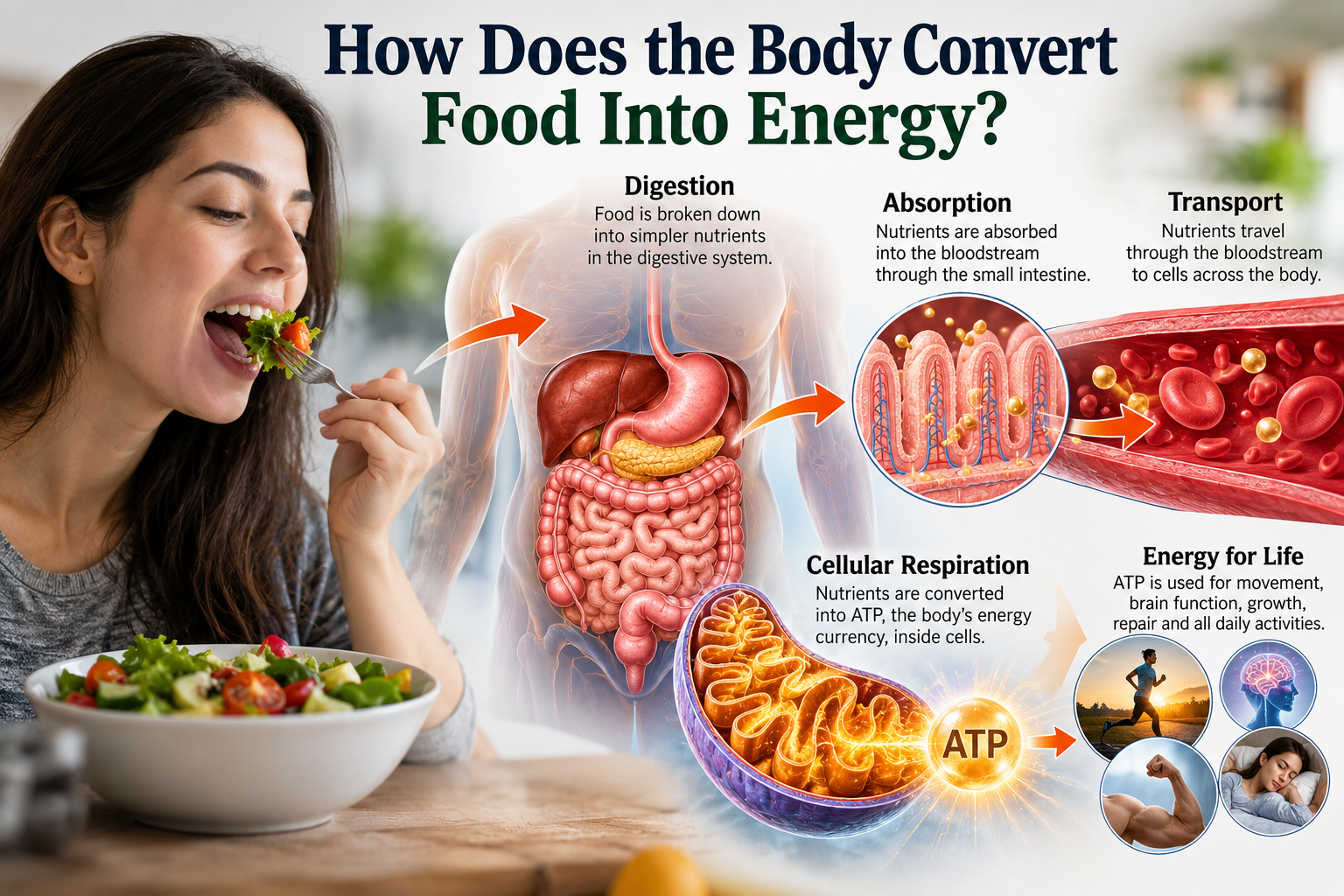
Food is one of the most important sources of energy for the human body. Every movement, heartbeat, breath, and thought depends on energy that comes from the food we eat. Even when a person is sleeping or resting, the body continues to use energy to maintain essential functions. Understanding how the body converts food into energy helps us appreciate the connection between nutrition, digestion, metabolism, and overall health.
The human body works like a complex biological system that transforms nutrients into usable energy. This process involves several organs, enzymes, hormones, and chemical reactions. Food does not become energy immediately after eating. It must first be digested, absorbed, transported, and processed by cells.
The energy produced through these processes allows the body to perform daily activities, repair damaged tissues, maintain body temperature, and support growth. Learning about food energy conversion also explains why balanced nutrition is important for maintaining a healthy lifestyle.
What Does Food Energy Mean?
Food energy refers to the chemical energy stored in nutrients such as carbohydrates, proteins, and fats. The body releases this energy through metabolic reactions and uses it to support biological activities.
Energy in food is commonly measured in calories. In nutrition, the word calorie usually refers to a kilocalorie, which represents the amount of energy available from food.
Different nutrients provide different amounts of energy.
Carbohydrates provide approximately 4 calories per gram. Proteins also provide about 4 calories per gram, while fats provide approximately 9 calories per gram.
These nutrients serve different purposes in the body. Carbohydrates are an important source of readily available energy, fats provide concentrated energy and support several biological functions, and proteins primarily help build and repair body tissues.
The body uses these nutrients according to its immediate needs, activity level, and nutritional condition.
How Does Digestion Begin the Energy Conversion Process?
The conversion of food into energy begins with digestion. Digestion breaks large food molecules into smaller substances that the body can absorb and use.
When food enters the mouth, teeth break it into smaller pieces. Saliva contains an enzyme called amylase, which begins breaking down starch into smaller carbohydrate molecules.
After swallowing, food travels through the esophagus into the stomach. The stomach mixes food with digestive juices and helps break it down further.
Stomach acid and digestive enzymes are particularly important for protein digestion.
The partially digested food then enters the small intestine, where most nutrient digestion and absorption take place.
The pancreas releases digestive enzymes that help break down carbohydrates, proteins, and fats. The liver produces bile, which is stored in the gallbladder and helps the body digest fats.
Through these combined activities, food is transformed into nutrients that can enter the bloodstream or lymphatic system.
This digestive process prepares nutrients for the next stage of energy production.
How Are Nutrients Absorbed Into the Bloodstream?
After digestion, the body must absorb nutrients before they can be used for energy.
The small intestine contains millions of tiny structures called villi. These structures increase the surface area available for nutrient absorption.
Carbohydrates are broken down into simple sugars, including glucose. Glucose is absorbed into the bloodstream and transported to different tissues.
Proteins are digested into amino acids and small peptides. Most absorbed amino acids enter the bloodstream and travel to the liver and other body tissues.
Dietary fats are broken down into fatty acids and other components. Most long chain fatty acids are packaged into particles called chylomicrons and enter the lymphatic system before reaching the bloodstream.
Once nutrients have been absorbed, the circulatory system helps deliver them to cells throughout the body.
Each cell then processes available nutrients according to its energy requirements.
Why Is Glucose Important for Energy Production?
Glucose is one of the most important energy sources used by the human body. It is a simple sugar produced during carbohydrate digestion.
Foods such as rice, bread, potatoes, fruits, and cereals contain carbohydrates that can contribute to the body’s glucose supply.
After eating carbohydrates, blood glucose levels generally rise. The pancreas responds by releasing insulin, a hormone that helps regulate blood glucose.
Insulin allows many body cells, particularly muscle and fat cells, to increase their glucose uptake. It also promotes glucose storage and helps regulate energy metabolism.
Once glucose enters a cell, it can be used to produce energy.
Certain tissues have a particularly strong dependence on glucose. Red blood cells rely on glucose because they do not contain mitochondria. The brain also uses substantial amounts of glucose under ordinary conditions, although it can use ketone bodies during prolonged fasting.
Maintaining normal blood glucose levels is therefore important for healthy body functioning.
What Is Cellular Respiration?
Cellular respiration is the process through which cells extract usable energy from nutrients.
This process takes place through a series of chemical reactions that convert energy stored in glucose and other fuels into a molecule called adenosine triphosphate, commonly known as ATP.
ATP is often described as the energy currency of the cell because it supplies energy for many cellular activities.
Cells use ATP for muscle contraction, active transport of substances, chemical synthesis, and other essential functions.
During aerobic cellular respiration, oxygen helps cells extract large amounts of usable energy from glucose.
The overall reaction can be represented as follows:
Glucose + Oxygen → Carbon Dioxide + Water + Energy
Some of the released energy is captured in ATP, while some is released as heat.
This process demonstrates how the nutrients obtained from food eventually support the body’s everyday activities.
How Does the Body Produce ATP From Glucose?
The conversion of glucose into ATP involves several important stages.
1. Glycolysis
Glycolysis is the first stage of glucose breakdown. It occurs in the cytoplasm of the cell.
During glycolysis, one glucose molecule is divided into two smaller molecules called pyruvate.
This process produces a small amount of ATP and molecules that carry high energy electrons.
Glycolysis does not directly require oxygen, which means it can continue even when oxygen availability is limited.

2. The Citric Acid Cycle
When oxygen is available and cells have functioning mitochondria, pyruvate can be converted into acetyl CoA.
Acetyl CoA enters the citric acid cycle, also known as the Krebs cycle.
This cycle takes place in the mitochondrial matrix and releases carbon dioxide while producing electron carriers.
These carriers transport high energy electrons to the next stage of cellular respiration.
3. The Electron Transport Chain
The electron transport chain is located in the inner membrane of mitochondria.
It uses electrons carried by specialized molecules to establish a proton gradient across the membrane.
An enzyme called ATP synthase uses this gradient to produce ATP.
Oxygen acts as the final electron acceptor, allowing the process to continue and helping form water.
Under typical conditions, the complete aerobic breakdown of one glucose molecule produces approximately 30 to 32 ATP molecules.
This process supplies a substantial amount of the energy required for normal cellular functions.
What Is the Role of Mitochondria in Energy Production?
Mitochondria are specialized structures found in most human cells. They are commonly called the powerhouses of the cell because they produce much of the ATP used during aerobic metabolism.
Muscle cells and certain other highly active cells contain many mitochondria because they require significant amounts of energy.
Mitochondria process products derived from carbohydrates, fats, and some amino acids.
They also participate in other important functions, including calcium regulation and cellular signaling.
Healthy mitochondrial activity supports normal energy production. However, mitochondria cannot work independently. They rely on a continuous supply of suitable nutrients and, for aerobic respiration, oxygen.
This relationship explains why digestion, circulation, breathing, and cellular metabolism must work together.
How Does the Body Convert Fat Into Energy?
Fat is an important energy source, particularly during prolonged physical activity and periods between meals.
When the body requires additional energy, stored triglycerides can be broken down into fatty acids and glycerol.
Fatty acids travel to tissues where they can be used as fuel.
Inside suitable cells, fatty acids undergo a process called beta oxidation, which produces acetyl CoA.
The acetyl CoA can then enter the citric acid cycle, supporting ATP production.
Because fat contains more energy per gram than carbohydrates or proteins, it serves as an efficient form of stored energy.
The body stores excess energy primarily in adipose tissue, which can release fatty acids when required.
Dietary fat also supports cell membranes, hormone production, and the absorption of vitamins A, D, E, and K.
Therefore, fat is not simply an energy reserve. It is an essential part of normal nutrition and metabolism.
Can the Body Use Protein for Energy?
Protein mainly supports tissue growth, muscle maintenance, enzyme formation, and cellular repair.
However, the body can also use amino acids for energy when necessary.
During protein metabolism, amino acids may undergo reactions that remove their nitrogen containing groups.
The remaining carbon structures can enter various metabolic pathways to support ATP production.
The liver converts much of the resulting nitrogen waste into urea, which the kidneys help remove through urine.
Although protein can provide energy, the body benefits from having adequate carbohydrates and fats available so that dietary protein can support its other essential functions.
A balanced diet helps the body meet both its energy and tissue maintenance needs.
How Does the Body Store Extra Energy?
The body does not immediately use all the energy obtained from food.
Some glucose is stored as glycogen in the liver and muscles.
Liver glycogen helps maintain blood glucose between meals, while muscle glycogen provides an important fuel source during physical activity.
However, glycogen storage capacity is limited.
When energy intake consistently exceeds energy expenditure, the body can store additional energy as fat.
These fat stores act as long term energy reserves.
When food intake decreases or physical activity increases, the body can draw on stored energy to meet its needs.
Energy storage and energy release are continuously regulated by hormones, nutrient availability, and the body’s metabolic demands.
What Is Metabolism and How Does It Affect Energy?
Metabolism refers to the chemical reactions that occur inside the body to maintain life.
It includes processes that break down nutrients to release energy and processes that use energy to build or maintain tissues.
The amount of energy a person uses depends on several factors, including age, body size, body composition, physical activity, and health.
Even at rest, the body requires energy for breathing, circulation, temperature regulation, and cellular maintenance.
This resting energy requirement accounts for a large portion of daily energy expenditure for many people.
Physical activity increases energy use because muscles require additional ATP during movement.
Digestion and nutrient processing also require energy, a process known as the thermic effect of food.
Together, these activities determine the body’s total daily energy needs.
Why Is Oxygen Necessary for Efficient Energy Production?
Oxygen plays an essential role in aerobic cellular respiration.
When we breathe, oxygen enters the lungs and passes into the bloodstream.
Red blood cells transport oxygen through a protein called hemoglobin.
The circulatory system then delivers oxygen to tissues throughout the body.
Inside mitochondria, oxygen allows the electron transport chain to function effectively.
Without sufficient oxygen, cells cannot maintain their normal rate of aerobic ATP production.
During intense exercise, muscles can increase their reliance on glycolysis, which can produce ATP without directly using oxygen.
However, this pathway produces much less ATP per glucose molecule than complete aerobic respiration.
This is one reason healthy respiratory and cardiovascular functions are important for physical endurance.
How Does Physical Activity Influence Food Energy Conversion?
Physical activity increases the body’s demand for ATP.
During exercise, working muscles use stored ATP and continuously produce more energy from available fuels.
For short periods of intense activity, muscles rely heavily on rapid energy systems, including phosphocreatine breakdown and glycolysis.
During longer periods of activity, aerobic metabolism becomes especially important.
Depending on exercise intensity and duration, the body uses different proportions of carbohydrates and fats.
Regular exercise can improve several aspects of energy metabolism, including insulin sensitivity and the muscles’ capacity for aerobic energy production.
These adaptations help the body use available nutrients more effectively during physical activity.
Why Is Balanced Nutrition Important for Energy Production?
Efficient energy production requires more than simply eating enough calories.
The body also needs vitamins, minerals, water, and other essential nutrients.
B vitamins participate in metabolic reactions that help cells release energy from carbohydrates, fats, and proteins.
Iron supports oxygen transport through hemoglobin and contributes to normal cellular energy processes.
Magnesium is involved in many reactions associated with ATP.
Water supports nutrient transport, chemical reactions, circulation, and temperature regulation.
Whole grains, fruits, vegetables, legumes, dairy products, eggs, fish, lean meats, nuts, and seeds can all contribute valuable nutrients to a balanced diet.
Eating a variety of nutritious foods helps provide the substances required for normal metabolism.
Regular meals, adequate hydration, sufficient sleep, and appropriate physical activity also support overall energy balance.
Conclusion
The process of converting food into energy is one of the most important functions of the human body. It begins with digestion, continues through nutrient absorption, and involves complex metabolic reactions inside cells.
Carbohydrates, fats, and proteins provide chemical energy that the body can transform into ATP. Glucose is processed through glycolysis and other cellular pathways, while fats and certain amino acids can also serve as valuable energy sources.
Mitochondria, oxygen, enzymes, and hormones all contribute to this carefully regulated process.
Understanding how the body converts food into energy highlights the importance of balanced nutrition and healthy daily habits. By eating nutritious foods, remaining physically active, drinking sufficient water, and getting adequate rest, people can support the biological processes that keep their bodies functioning throughout life.